The Skin Color of the Bird Reflects the Birds Culinary Arts
Human being uses of birds have, for thousands of years, included both economic uses such as food, and symbolic uses such as art, music, and religion.
In terms of economic uses, birds accept been hunted for food since Palaeolithic times. They have been captured and bred as poultry to provide meat and eggs since at least the fourth dimension of ancient Egypt. Some species have been used, as well, to assistance locate or to grab food, equally with cormorant fishing and the utilize of honeyguides. Feathers have long been used for bedding, likewise as for quill pens and for fletching arrows. Today, many species face up habitat loss and other threats caused past humans; bird conservation groups work to protect birds and to influence governments to do so.
Birds take appeared in the mythologies and religions of many cultures since aboriginal Sumer. For case, the dove was the symbol of the aboriginal Mesopotamian goddess Inanna, the Canaanite mother goddess Asherah, and the Greek goddess Aphrodite. Athena, the Greek goddess of wisdom, had a little owl as her symbol, and, in ancient Republic of india, the peacock represented Mother Earth. Birds have often been seen every bit symbols, whether bringing bad luck and decease, being sacred, or being used in heraldry. In terms of amusement, raptors have been used in falconry, while cagebirds have been kept for their song. Other birds take been raised for the traditional sports of cockfighting and pigeon racing. Birdwatching, too, has grown to become a major leisure activity. Birds characteristic in a wide multifariousness of art forms, including in painting, sculpture, poetry and prose, film and way. Birds too appear in music as well equally traditional dance and ballet. In certain cases, such every bit the bird-and-flower painting of China, birds are central to an artistic genre.
Context [edit]
Civilisation consists of the social behaviour and norms found in human societies and transmitted through social learning. Cultural universals in all human societies include expressive forms like fine art, music, dance, ritual, organized religion, and technologies like tool usage, cooking, shelter, and clothing. The concept of textile culture covers physical expressions such every bit applied science, architecture and fine art, whereas immaterial culture includes principles of social organization, mythology, philosophy, literature, and scientific discipline.[ane] This article describes the roles played past birds in human civilization, so divers.
Economical uses [edit]
Birds are important economically, providing substantial amounts of food, particularly poly peptide, largely merely not exclusively from the domestic chicken;[2] [3] feathers and downwards are used for bedding, insulation, and other purposes.[4]
As food [edit]
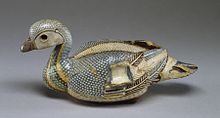
Birds were among the wild fauna hunted for food before the Neolithic revolution and the development of agriculture. For example, in the Epipaleolithic of the Levant, betwixt c. 14,500 and 11,500 BP, both waterfowl and migratory birds were eaten.[5] Archaeologists have studied the return in terms of energy from captured nutrient compared to the energy expended to capture it; birds provide a smaller return than larger game such as deer, but better than many plant materials. For example, waterfowl captured in a bulldoze tin can yield a render of around 2,000 kcal/60 minutes, whereas an antelope tin yield every bit much as 31,000 kcal/hour, and wild rye around 1,000 kcal/hour.[six]
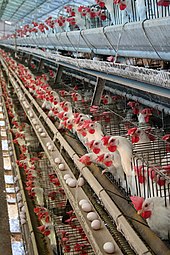
Bombardment hens: poultry is a major source of food, the chicken alone providing 20% of the world'south animal poly peptide.[seven]
Birds accept been domesticated and bred as poultry for use as nutrient for at least four thou years. The well-nigh important species is the craven. It appears to take been domesticated past 5000 BC in northeastern Cathay, likely for cockfighting, and only afterward used for food.[2] In ancient Egypt, poultry including ducks, geese, and pigeons were captured in nets and then bred in captivity.[8]
Chicken at present provides some xx% of the fauna protein eaten by the world's human population in the form of meat and eggs. Chickens are oftentimes raised intensively in bombardment farms; this facilitates production simply has been criticised on animal welfare grounds.[3] Other species including ducks, geese, pheasants, guineafowl and turkeys are significant economically around the earth.[seven] Less commonly raised species such as the ostrich are starting to be farmed for their meat, which is depression in cholesterol; they have also been kept for their feathers, and for leather from their skin.[9]
Birds are hunted in many countries around the world. In the developed world, ducks such as mallard, wigeon, shoveler and teal have for centuries been captured by wildfowlers, while pheasants, partridges, grouse, and snipe are among the terrestrial birds that are hunted for sport, generally with guns.[ten] In other parts of the globe, traditional subsistence hunting still continues, as in rural Northern Papua, where cassowaries, crowned pigeons, hornbills and megapodes are captured for food.[11] Seabirds such as muttonbirds, penguins and auks have been hunted for food, formerly with sufficient intensity to threaten many populations and to make some, such as the keen auk, extinct.[12] [xiii] [14] Seabird hunting continues at more moderate levels today, for instance with the traditional Māori harvest of sooty shearwater chicks.[xv]
Assisting hunters and gatherers [edit]

The archaeological and historical records suggest interdependence between humans and vultures for millions of years. Like other fauna species, early on hominins probably used these birds as beacons signalling the location of meat, in the course of carcasses, in the mural.[16]
Cormorant line-fishing is a traditional fishing method in which trained cormorants are used to catch fish in rivers. Historically, cormorant line-fishing has taken place in Japan and China since nearly 960 AD.[17]
The greater honeyguide guides people in some parts of Africa to the nests of wild bees.[18] A guiding bird attracts a person's attending with a chattering call, and flies in short bounds towards a bees' nest. When the human honey-hunter has taken their honey, the honeyguide eats what is left.[xix] [twenty] The Boran people of East Africa use a specific whistle, which doubles the encounter rate with honeyguides; they find that using a honeyguide reduces the time to discover dear past two-thirds.[18] The Bushmen of the Kalahari thank the honeyguide with a gift of honey.[20]
Materials [edit]
Feathers are used to brand warm and soft bedding, including eiderdowns from the belly down of the eider duck, and wintertime clothing equally they take high "loft", trapping a big amount of air for their weight.[21] Feathers were used besides for quill pens,[22] for fletching arrows,[23] and to decorate angling lures.[24]
Bird basic were used by Stone Age peoples to make awls and other tools.[25] Guano, the droppings of seabirds, rich in nitrogen, phosphorus, and potassium, was once important as an agricultural fertiliser and is still used in organic farming.[26] The War of the Pacific in 1865 was in office near which state had control of the territory containing valuable guano sources.[27] Today, birds such as the chicken and the Japanese quail are used as model organisms in ornithological and more generally in biological research, for instance in toxicology.[28] [29]
Wear and fashion [edit]

Bororo men wearing brightly-coloured feathered headdresses
Feathers have been important and colourful items of wear and style from before the nascency of civilisation. Elaborate, brightly coloured headdresses containing feathers are worn by indigenous peoples of the Americas such as the Bororo of the Mato Grosso.[30] In Polynesia, sega ula lory bird feathers were major trade items, used to decorate loftier quality mats in Samoa and Tonga.[31] The use of bird skins for Inuit clothing has been documented beyond all Inuit groups, although it was nigh common in the eastern and western Arctic, where larger animals similar caribou were less available.[32] [33]
In Western civilisation, feathers are used in boas and decorating elaborate hats and other items of ladies' wearable. Feathers in fashion were a status symbol well into the nineteenth and twentieth centuries. The Belle Epoque draped its clothing in feathers equally ornaments.[34] Ostrich plumes were a luxury article in Europe for centuries, leading to serious harm to wild ostrich populations, and subsequent establishment of ostrich farms.[35] Classical 1930s Hollywood films used feathers in abundance, arguably as a metaphor for female sexuality. For example, in the 1935 musical Top Hat, Ginger Rogers danced "Cheek to Cheek" covered in white plumes that emphasised her movements.[36] Late twentieth century designers such equally Yves Saint Laurent and Alexander McQueen used feathers to make mode statements.[37]
Sports and hobbies [edit]

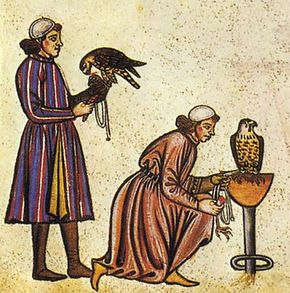
Raptors from eagles to small falcons accept for centuries been used in falconry, often to catch other birds, whether for pleasure or for food.[38]
Cockfighting is an ancient spectator sport. It formed part of the culture of the ancient Indians, Chinese, Greeks, and Romans. It continues to be practised in S America and across S and Southeast Asia, ofttimes combined with betting on the result.[39] [twoscore] It is practised in religious ceremonies in Hindu temples in Bali,[41] but is at present banned in many countries on grounds of cruelty.[39]
Pigeon racing involves releasing specially trained racing pigeons to return to their homes over a measured distance of between 100 and 1,000 kilometres (62 and 621 mi). The sport was popularised in Belgium in the 19th century, and is at present competitive worldwide.[42] Likewise in Belgium and Flemish region is vinkensport, in which participants have male chaffinches compete to make the most bird calls in an hr.[43]
Birdwatching has since the nineteenth century become a major leisure activity.[44] [45] Millions of people around the world, amounting to nearly half of all households in some adult countries, put out birdfeeders to attract birds to their gardens or windowsills, at a cost of billions of dollars each year.[46] [47] [48]
Every bit pets [edit]
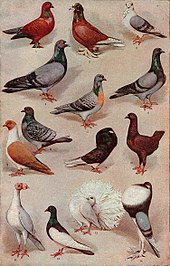
Cagebirds such equally canaries, budgerigars, cockatoos, lovebirds, quails, finches, and parrots are popular pets, whether for their song, their behaviour, their colourful plumage, or their ability to mimic spoken language. Among reasons for their popularity is that they tin be kept in homes also pocket-size or otherwise unsuitable for dogs or cats.[50] [51] [52] [53] The cagebird trade in some parts of the world threatens certain species with extinction, when birds are illegally captured in the wild. For instance, in Indonesia, at least 13 species are close to extinction including the Indonesian national bird, the Javan hawk-eagle, while v subspecies including the cerise-breasted lorikeet may accept become extinct in the wild.[54]
Pet birds are kept in their millions, as are domestic fowls, bantams, and pigeons.[55] [56] These concluding had an important effect on evolutionary biology, as Charles Darwin took an especial interest in pigeon fancying, adopted the hobby himself, and made use of the wide variation between breeds equally an argument for the power of choice in his 1859 Origin of Species.[49]
Symbolic uses [edit]
Inspiration [edit]
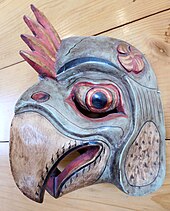
Wooden mask in form of a chicken. Bali, belatedly 20th century
The nature writers Marking Cocker and Richard Mabey, reviewing people's love of birds, detect that people are touched by feelings for birds in a diverseness of ways, such equally enjoying the lapwing'due south "joyous display",[57] or the "beauty and mystery" of the tawny owl's call on a common cold winter's night.[57] They argue that people feel the simple companionship of birds, are inspired by them to create fine art, let them marking the seasons and provide a sense of place, and use them "as symbols of joy and love".[57] A former statesman, Edward Grey, 1st Viscount Grayness of Fallodon, was able to express his feeling for birds in his 1927 book The Charm of Birds.[58] Such feelings, in turn, have stimulated the intention to conserve birds and their habitats.[57] Effectually the same time as Grey was writing, the first conservation organisations were coming into beingness, starting in Britain, triggered by the rapid disappearance of familiar species equally they were captured for their feathers or for food.[57] A substantial sociology rich in symbolism has accrued around birds; information technology was documented early in the 20th century equally something that was already fading from retention. For example, the house sparrow has been associated with "sex and lechery"[57] since ancient Egypt, where carnality was written with the sparrow hieroglyph. In the same vein, in the classical era the sparrow was sacred to the goddess of dearest, Aphrodite or Venus; the sparrow features in an erotic verse form by Catullus for the same reason. Chaucer describes the summoner in his Canterbury Tales as being as "lecherous as a sparwe".[57] [59] [60]
Studies take shown how important birds are to private societies, touching on all aspects of life. In Andean societies such as the Moche (1–800 AD), Nazca (100–700 AD) and Chimu (1150–1450 Advertizement), vivid parrot and macaw feathers were traded from the Amazon rainforest to the mountains and the Pacific declension, while guano was nerveless equally a fertiliser, and artists and craftsmen were inspired to create textiles, metal jewellery, and ceramics depicting condors, cormorants, ducks, hummingbirds, owls, vultures, and waders. Their religions, as well, endowed birds with symbolic meaning.[61]

The Audubon lodge, reviewing the importance of birds in 2013, obtained statements from many people with differing perspectives. Among them, the guild's science director, Gary Langham, noted that what is good for birds is also skilful for humans. The writer David Allen Sibley observed that birds bring a little wildness into parks and gardens.[62] The author Barbara Kingsolver noted that birds are part of life on world. The actress Jane Alexander wrote "Birds remind united states of america that at that place are angels."[62] The forensic ornithologist Carla Dove noted that birds are biological indicators of habitat health, climate change, and the coming of spring.[62]
Symbolism and heraldry [edit]

Birds have been seen as symbols, and used equally such, though perceptions of bird species vary widely across cultures: some birds have a positive epitome in some regions, a negative image in others. Owls are associated with bad luck, witchcraft, and expiry in parts of Africa,[63] but are regarded as wise across much of Europe.[64] Hoopoes were considered sacred in Ancient Egypt and symbols of virtue in Persia, but were thought of as thieves across much of Europe, and harbingers of war in Scandinavia.[65]
In heraldry, birds, especially eagles, often appear in coats of artillery.[66] In Britain, over 3000 pubs accept birds in their names, sometimes commemorating a local family with a bird from their coat of artillery, sometimes for other reasons. At that place are dozens of pubs named "Crow's Nest" (nautical), "Canis familiaris & Duck" (wildfowling), "Eagle & Child" (heraldic), and "Falcon" (heraldic, or falconry), while over 600 pubs are named for swans.[67]
Birds, too, may symbolise human attributes such as stupidity or talkativeness. People accept been called "birdbrain[ed]" or "cuckoo", amid many other animate being epithets.[68] Birds feature prominently in often derogatory similes like "noisy as a goose" and metaphors including "to parrot".[69]
Mythology and religion [edit]

Birds have appeared in mythology and religion in a variety of guises.
Birds have featured as gods from the time of ancient Egypt, where the sacred ibis was venerated as a symbol of the god Thoth.[seventy] In India, the peacock is perceived as Mother Globe among Dravidian peoples,[71] while the Mughal and Farsi emperors displayed their godlike authority by sitting in a Peacock Throne.[72] In the Yazidi religion, Melek Taus the "Peacock Angel" is the central figure of their faith.[73] In the cult of Makemake, the Tangata manu birds of Easter Island served as chiefs.[74]

Butterfly-shaped ivory vessel with the pattern of 2 birds facing the sun, which demonstrates the sacred primitive conventionalities of Hemudu people. Hemudu culture, c. 5500-3300 BC
Birds accept been seen equally spirit messengers of the gods. In Norse mythology, Hugin and Munin were ravens who whispered news into the ears of the god Odin.[75] In the Etruscan and Roman religions of ancient Italian republic, priests were involved in augury, interpreting the words of birds while the "auspex" watched their activities to foretell events.[76] In the Inca and Tiwanaku empires of Southward America, birds are depicted transgressing the boundaries between the earthly and underground spiritual realms.[77] Indigenous peoples of the fundamental Andes maintain legends of birds passing to and from metaphysical worlds.[78] The mythical chullumpi bird is said to mark the existence of a portal between such worlds, and to transform itself into a llama.[78] [79] Among the Parsees of Republic of india and Iran, and amongst practitioners of Vajrayana Buddhism who believe in the transmigration of souls in Sikkim, Mongolia, Bhutan and Nepal, sky burying has been practised for centuries. In this ritual, corpses are left exposed for griffon vultures to pick clean.[fourscore] The practice is failing, not to the lowest degree because of the loss of nearly of the vulture population beyond South Asia to accidental poisoning past the anti-inflammatory veterinary drug diclofenac.[81] [82]

Simurgh in tilework on Nadir Divan-Beghi Madrasah, Bukhara, Uzbekistan
Birds have sometimes served as religious symbols. In ancient Mesopotamia, doves were prominent animal symbols of Inanna (later known as Ishtar), the goddess of dearest, sexuality, and state of war,[83] [84] and, in the ancient Levant, doves were used as symbols for the Canaanite female parent goddess Asherah.[83] [84] [85] In ancient Hellenic republic, Athena, the goddess of wisdom and patron deity of the city of Athens, had a niggling owl equally her symbol.[86] [87] [88] In Greek iconography, Athena is often shown accompanied by an owl[88] and the owl was used as a symbol of Athens on Athenian coinage.[87] In classical antiquity, doves were sacred to the Greek goddess Aphrodite,[89] [ninety] [83] [84] who absorbed this association with doves from Inanna-Ishtar.[84] Aphrodite frequently appears with doves in aboriginal Greek pottery[89] and, during Aphrodite's primary festival, the Aphrodisia, her altars would be purified with the claret of a sacrificed dove.[91]
In Medieval Christian iconography, the cormorant's "wing-drying" pose represents the Christian cross, and hence is a figure of Christ. In John Milton'southward Paradise Lost, on the other manus, the bird'southward cross-like pose is a travesty of Christ: "And then upward he flew, and... Sat similar a cormorant; notwithstanding not true life Thereby regained, merely sat devising death To them who lived".[92] [93]
In mythology, birds were sometimes monsters, like the Roc and the Māori'south Pouākai , a giant bird capable of snatching humans.[94] In Western farsi mythology, the simurgh was a gigantic bird, the starting time to come into beingness, and information technology nested on the tree of plant life that grew in the smashing ocean beside the tree of immortality. Its task was to milk shake the seeds of all the plants out of the tree.[95]
In the arts [edit]
Birds have been depicted throughout the arts from the earliest times to the nowadays,[96] including in painting and sculpture, in literature, in music, in theatre, in traditional dance and ballet, and in moving-picture show.[57]

Painting and sculpture [edit]
Birds have been depicted in paintings, sculptures and other art objects from the primeval times, including in cave paintings.[96]
In Chinese art, bird-and-flower painting forms one of the three major subjects (the others beingness landscapes and figures), from the fourth dimension of the Five Dynasties in the 10th century. Huang Quan created the naturalistic xiesheng style for bird paintings.[97] Birds have long been celebrated in the arts of Nippon, including in painting, woodblock printing, cloisonné, ceramics and indeed poetry from the 18th and 19th centuries. Print artists like Utamaro and Hokusai made utilize of Western and Chinese influences to give a sophisticated effect, while Hiroshige reworked the traditional bird-and-flower genre.[98]
In modern art, some of the paintings of Joan Miró include "A tangle of lines and pocket-sized, colored ideograms suggesting birds, allegorical characters, stars, and animals".[99] [100] In mod sculpture, Pablo Picasso's 1932 bronze Coq (Cockerel) is an assemblage of "spiky, elongated forms."[101]
In public bronze, the Magyars's mythical Turul symbolises national power and dignity, and is represented by many statues in Hungary, including the largest bird statue in the world, on a mountain near Tatabánya.[102] [103] [104]
Poesy [edit]
Birds have been celebrated in poetry since ancient times, when for instance the Roman poet Catullus wrote in ane of his well-nigh famous works nearly a daughter and her pet sparrow in Passer, deliciae meae puellae, "Sparrow, delight of my girl".[105]
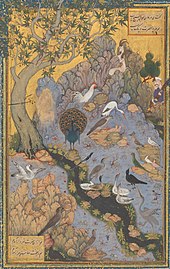
Birds featured in medieval poesy, for instance forming the characters of the 1177 Persian poem The Conference of the Birds, where the birds of the world gather nether the wisest bird, the hoopoe, to decide who is to be their king.[106]
In English romantic verse, John Keats'due south 1819 "Ode to a Nightingale" and Percy Bysshe Shelley'due south 1820 "To a Skylark" are popular classics.[107] [108] Bird poems past Gerard Manley Hopkins include "Sea and Skylark" and "The Windhover" (on the kestrel).[109] More than recently, Ted Hughes'southward 1970 collection of poems about a bird grapheme, "Crow", is considered one of his almost important works.[110] [111]
Prose [edit]

Birds have similarly appeared in literature from aboriginal times.[112] Among Aesop'due south Fables are The Wolf and the Crane[113] and The Fox and the Stork; these fables, which have analogues in eastern traditions such every bit the Buddhist Javasakuna Jataka,[114] use birds to imply moral conclusions near human behaviour.[115]
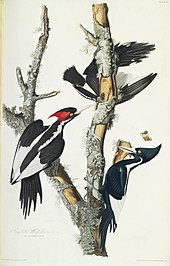
More than recently, birds have appeared in books illustrated past some exceptional artists, producing images that were accurate and beautiful, and that made use of the latest available printing techniques. The wood engraver Thomas Bewick's 1797–1804 A History of British Birds brought affordable illustrations to the public for the first time, and the book formed in effect the kickoff field guide to birds,[116] [117] while John James Audubon's enormous[118] and impressive images of birds in his 1827–1838 Birds of America are amongst the most admired by art critics[119] and by collectors: early editions fetch among the highest prices paid for whatever printed books.[120] The ornithologist John Gould's bird illustrations, in books such as A Century of Birds hitherto unfigured from the Himalaya Mountains (1830–1833) with fourscore plates, and his vii-volume The Birds of Australia (1840–1848) with 600 plates, related directly to his research, were both cute and scientifically useful.[121]
Birds are popular characters in children'due south books, which are often amply illustrated. Beatrix Potter's 1908 The Tale of Jemima Pool-Duck created an enduringly pop bird heroine.[122] Other authors followed with many bird characters in books for children of unlike ages.[123]
In books for adults, birds may have symbolic or psychological significance. For instance, Paul Gallico'due south 1940 The Snow Goose: A Story of Dunkirk was a parable about the regenerative power of friendship in wartime; the goose symbolises both the hero, Rhayader, a wounded artist, and the globe wounded by state of war.[124] T. H. White's 1951 The Goshawk describes the author'southward "monstrous and often cruel battles" to train his bird of prey, while Helen Macdonald's 2014 H is for Hawk, which references White's book, tells how her obsession with the same species as a falconer helped her through the loss of her male parent.[125]
Music [edit]
In music, birdsong has influenced composers and musicians in several ways: they can be inspired past birdsong; they can intentionally imitate bird song in a composition, as Vivaldi and Beethoven did, along with many afterward composers; they can incorporate recordings of birds into their works, first seen in the work of Ottorino Respighi; or as Beatrice Harrison did in 1924 with a nightingale, and David Rothenberg did in 2000 with a laughingthrush, they can duet with birds.[126] [127] [128]
At to the lowest degree two groups of scientists, namely Luis Felipe Baptista and Robin A. Keister in 2005, and Adam Tierney and colleagues in 2011, have argued that birdsong has a like structure to music. Baptista and Keister argue that the way birds use variations of rhythm, relationships of musical pitch, and combinations of notes is somewhat musical, peradventure considering some birds exploit variation in vocal to avoid monotony, or mimic other species.[129] Tierney argues that the similar motor constraints on human and avian song drive these to have like song structures, including "curvation-shaped and descending melodic contours in musical phrases", long notes at the ends of phrases, and typically small differences in pitch between next notes.[130]
Dance [edit]

Birds feature as primal characters in dance traditions effectually the earth. For example, Goldie'due south bird of paradise is celebrated in Papua New Guinea in a "beautiful"[131] dance by ii men who apparel in grass skirts with the bird's plumes on the rump; they carry cassowary feathers in their hands and on their armbands, and imitate the bird's calls while they trip the light fantastic. It is performed on of import occasions, conveying "special magic",[131] and the performers are obliged to set up for a week, avoiding certain foods, and undergoing a prolonged submergence in a cold stream to prepare their minds. The dance is preceded by a "magic chant" to the bird of paradise.[131] In Balinese dance, the cendrawasih dance illustrates the bird-of-paradise's mating rituals.[132]
In Africa, the Ewe people of Ghana, who were said to have been guided from Dahomey to Ghana by a bird, incorporate the flapping of the bird'south wings in dances such as Agbadza, Atsiagbekor, and Gakpa.[133]
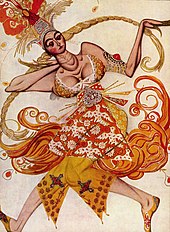
In ballet, Tchaikovsky'due south classical 1895 Swan Lake and Igor Stravinsky's 1910 The Firebird accept central bird characters.[134]
The dramatic arts [edit]

In theatre, Aristophanes'due south 414 BC comedy The Birds (Greek: Ὄρνιθες Ornithes) is an acclaimed fantasy with effective mimicry of birds. The play's chorus consists of characters playing many identifiable species, including the kingfisher, turtledove, and sparrowhawk; birds feature equally messengers and dancers, and several Athenians are compared to specific birds.[135] [136]
In picture show, birds tin can characteristic every bit the major driving force in a story, equally in Alfred Hitchcock'southward acclaimed 1963 The Birds. Loosely based on Daphne du Maurier'southward story of the same name, it tells the tale of sudden attacks on people by fierce flocks of birds.[137] A bird plays the role of an outlet for a person's feelings in Ken Loach's much admired[138] 1969 Kes. The film is based on Barry Hines's 1968 novel A Kestrel for a Knave, and tells the story of a young male child who comes of age by training a kestrel that he has taken from the nest.[138]
Birds feature also in the mass media with iconic blithe drawing characters such as Walt Disney's Donald Duck,[139] Warner Bros.'due south Tweety Pie,[140] and Walter Lantz'southward Woody Woodpecker. The species involved are non always discernible, though Woody has been claimed to exist based on the acorn or pileated woodpeckers.[141]
Conservation [edit]
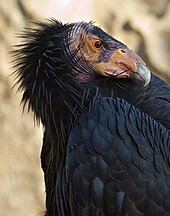
The California condor once numbered only 22 birds, merely conservation measures have raised that to over 300 today.
Though man activities have allowed the expansion of a few species, such as the barn swallow and European starling, they have caused population decreases or extinction in many other species. Over a hundred bird species have gone extinct in historical times, including the dullard and the great auk,[142] although the nearly dramatic human being-caused avian extinctions, eradicating an estimated 750–1800 species, occurred during the human colonisation of Melanesian, Polynesian, and Micronesian islands.[143] Many bird populations are failing worldwide, with 1,227 species listed every bit threatened past BirdLife International and the IUCN in 2009.[144] [145]
The well-nigh commonly cited human threat to birds is habitat loss.[146] Other threats include overhunting; adventitious mortality due to collisions with buildings and vehicles; long-line fishing bycatch;[147] pollution (including oil spills and pesticide use),[148] competition; predation; hybridisation from nonnative introduced or invasive species;[149] and climate change.[150] The collection of specimens for taxidermy and eggs from the wild has at times had a serious event on some species. Information technology is now forbidden in many countries, such as by the British Wildlife and Countryside Act 1981.[151] [152]
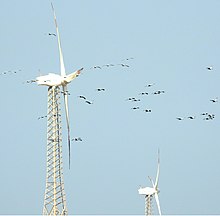
Effects are not all negative; for example, wind farms produce renewable energy, helping to mitigate the single greatest threat to birds, climate change. But, especially if wind farms are poorly sited, they may affect bird populations through disturbance, straight or indirect habitat loss, and collisions. Well sited wind farms benefit birds; poorly sited ones tin can kill many birds in collisions.[153] For case, at the Altamont Pass in California, the gilded hawkeye has been reduced by 80%, and nesting has ceased in the area.[154] Thus, at that place is a trade-off in the siting of any wind farm.[153]
Governments and conservation groups work to protect birds, either by passing laws that preserve and restore bird habitat, or by establishing captive populations for reintroductions. Such projects have produced some successes; one study estimated that conservation efforts saved 16 species of bird that would otherwise accept gone extinct between 1994 and 2004, including the California condor and Norfolk parakeet.[155] The British Purple Order for the Protection of Birds, founded every bit the Feather League in 1889 to protect birds such as the egret from hunting for their plumes, used in fashion, has grown to have over a 1000000 members; information technology has been followed past like societies in other countries.[156] A more than specialised organisation, the Wildfowl & Wetlands Trust founded in 1946, works to conserve waterfowl and their wetland habitats, with projects around the world.[157]
References [edit]
- ^ Macionis, John J.; Gerber, Linda Marie (2011). Sociology. Pearson Prentice Hall. p. 53. ISBN978-0137001613. OCLC 652430995.
- ^ a b Adler, Jerry; Lawler, Andrew (1 June 2012). "How the Chicken Conquered the World". Smithsonian Magazine . Retrieved 5 June 2017.
- ^ a b "Well-nigh egg laying hens". Pity in World Farming. Retrieved 26 May 2017.
- ^ Sheikh, Farhan (22 June 2013). "Poultry feathers-how many ways they can be used for?". The Poultry Guide.
- ^ Cummings, Vicki; Hashemite kingdom of jordan, Peter; Zvelebil, Marek (2014). The Oxford Handbook of the Archaeology and Anthropology of Hunter-Gatherers. Oxford Academy Press. p. 239. ISBN978-0-19-102526-6.
- ^ Kelly, Robert L. (2013). The Lifeways of Hunter-Gatherers: The Foraging Spectrum. Cambridge University Printing. pp. 53–56. ISBN978-1-107-02487-eight.
- ^ a b "History of Poultry". The Poultry Order of Great britain. Archived from the original on 28 February 2014. Retrieved 22 April 2016.
- ^ Manuelian, Peter der (1998). Arab republic of egypt: The World of the Pharaohs. Cologne, Germany: Könemann. p. 381. ISBN3-89508-913-iii.
- ^ Shanawany, Thou. M. "Recent developments in ostrich farming". Food and Agriculture Organization. Retrieved 22 April 2016.
- ^ Marchington, John (1980). History of Wildfowling. A & C Black. ISBN978-0-713-62053-5.
- ^ Pangau-Adam, Margaretha; Noske, Richard (2010). Tideman, Sonia; Gosler, Andrew (eds.). Wildlife Hunting and Bird Trade in Northern Papua (Irian Jaya), Republic of indonesia. Aboriginal stories: The riches and colour of Australian birds. Earthscan. pp. 74–85.
- ^ Simeone, A. & Navarro, X. (2002). "Homo exploitation of seabirds in coastal southern Chile during the mid-Holocene". Rev. Chil. Hist. Nat. 75 (2): 423–431. doi:10.4067/S0716-078X2002000200012.
- ^ Anderson, A. (1996). "Origins of Procellariidae Hunting in the Southwest Pacific". International Periodical of Osteoarcheology. 6 (4): 403–410. doi:10.1002/(SICI)1099-1212(199609)6:4<403::AID-OA296>3.0.CO;2-0.
- ^ Burnham, West.; Burnham, K. M.; Cade, T. J. (2005). "Past and nowadays assessments of bird life in Uummannaq District, West Greenland" (PDF). Dansk Orn. Foren. Tidsskr. 99: 196–208.
- ^ McGonigal, David (2008). Antarctica: Secrets of the Southern Continent. Firefly Books. p. 220. ISBN978-1-55407-398-6.
- ^ Morelli, F.; Kubicka, A.; Tryjanowski, P.; Nelson, N. (2015). "The vulture in the sky and the hominin on the land: three million years of human being-vulture interaction". Anthrozoös. 28 (3): 449–468. doi:10.1080/08927936.2015.1052279. S2CID 146652938.
- ^ Jackson, C. Due east. (1997). "Line-fishing with cormorants". Athenaeum of Natural History. 24 (ii): 189–211. doi:ten.3366/anh.1997.24.2.189.
- ^ a b Isack, H. A.; Reyer, H.-U. (1989). "Honeyguides and honey gatherers: interspecific communication in a symbiotic relationship". Scientific discipline. 243 (4896): 1343–1346. doi:ten.1126/science.243.4896.1343. PMID 17808267. S2CID 4220280.
- ^ Short, Lester; Horne, Jennifer (2002). "Family unit Indicatoridae (Honeyguides)". In Josep Del Hoyo; Andrew Elliott; Jordi Sargatal (eds.). Handbook of the Birds of the World: Jacamars to Woodpeckers, Vol. vii . Lynx. ISBN84-87334-37-vii.
- ^ a b Short, Lester; Horne, Jennifer; Diamond, A. W. (2003). "honeyguides". In Christopher Perrins (ed.). Firefly Encyclopedia of Birds. Firefly Books. pp. 396–397. ISBNane-55297-777-iii.
- ^ Bonser, R.H.C. & Dawson, C. (1999). "The structural mechanical properties of down feathers and biomimicking natural insulation materials". Periodical of Materials Science Messages. 18 (21): 1769–1770. doi:10.1023/A:1006631328233. S2CID 135061282.
- ^ "The Quill Pen". Colonial Williamsburg Foundation. Retrieved 22 April 2016.
- ^ Massey, Jim (1992). Hamm, Jim (ed.). Self Arrows. The Traditional Bowyer's Bible Volume One. Lyons Press. ISBN1-58574-085-three.
- ^ Wakeford, Jacqueline (1992). Wing Tying Tools and Materials. Lyons & Burford. pp. Preface. ISBNone-55821-183-7.
- ^ "Os Tools". University of Iowa Office of the Country Archeologist. Retrieved 22 April 2016.
- ^ Cushman, Gregory T. (2013). Guano and the Opening of the Pacific World: A Global Ecological History. Cambridge and New York: Cambridge University Press. ISBN9781107004139.
- ^ "The Guano War of 1865–1866". Earth History at KMLA. Retrieved 23 April 2016.
- ^ Burt, D. Westward. (2007). "Emergence of the Chicken as a Model Organism: Implications for Agriculture and Biology". Poultry Scientific discipline. 86 (seven): 1460–1471. doi:x.1093/ps/86.7.1460. PMID 17575197.
- ^ Jaspers, Veerle 50. B. (2015). "Selecting the right bird model in experimental studies on endocrine disrupting chemicals". Frontiers in Ecology Science. three (35). doi:x.3389/fenvs.2015.00035.
- ^ "Bororo Headdress". Indian-cultures.com. Archived from the original on 24 September 2017. Retrieved 23 April 2016.
- ^ Barnes, Shawn Due south.; Hunt, Terry L. (September 2005). "Sāmoa's Pre-Contact Connections In West Polynesia And Beyond". The Journal of the Polynesian Society. 114 (three): 227–266. JSTOR 20707289.
- ^ Issenman, Betty Kobayashi (1997). Sinews of Survival: the Living Legacy of Inuit Vesture. Vancouver: UBC Printing. p. 36. ISBN978-0-7748-5641-6. OCLC 923445644.
- ^ Template:Xite book
- ^ "Birds of Paradise. Plumes and Feathers in Fashion".
- ^ Bourn, Aomar; Bonine, Michael (2015). "The elegant plumage: ostrich feathers, African commercial networks, and European capitalism". Journal of North African Studies. 20 (two): 5–26. doi:10.1080/13629387.2014.983733. S2CID 145784798.
- ^ Dirix, Emmanuelle (ane March 2014). "Birds of paradise: Feathers, fetishism and costume in classical Hollywood". Film, Fashion & Consumption. 3 (1): 15–29. doi:10.1386/ffc.3.one.15_1.
- ^ Stratford, Oli (twenty March 2014). "Birds of Paradise. Plumes and Feathers in Fashion". Disegno.
- ^ "History of Falconry". The Falconry Eye. Retrieved 22 Apr 2016.
- ^ a b Crews, Ed. "Once Popular and Socially Acceptable: Cockfighting". Colonial Williamsburg Foundation. Retrieved 22 April 2016.
- ^ Lawler, Andrew (2 December 2014). "Birdmen. Cockfighters spread the craven across the world". Slate. Retrieved 22 April 2016.
- ^ Melt, William (3 January 2015). "Cockfighting: the last, hidden link to Bali's warlike by". The Spectator. Retrieved 22 April 2016.
- ^ Levi, Wendell (1977). The Pigeon. Levi Publishing. pp. iv, 40. ISBN0-85390-013-2.
- ^ Dan, Bilefsky (21 May 2007). "Ane-Ounce Belgian Idols Vie for Most Tweets per Hour". The New York Times.
- ^ Dunne, Pete (2003). Pete Dunne on Bird Watching. Houghton Mifflin. ISBN0-395-90686-5.
- ^ Oddie, Bill (1980). Bill Oddie'due south Little Black Bird Book. Butler & Tanner. ISBN0-413-47820-iii.
- ^ "Bird Feeding Basics". Audubon. 2004. Archived from the original on 11 August 2010. Retrieved 22 Apr 2016.
- ^ "Feeding birds". The Imperial Social club for the Protection of Birds. 3 November 2009. Retrieved 22 April 2016.
- ^ Tryjanowski, Piotr; et al. (2015). "Urban and rural habitats differ in number and type of bird feeders and in bird species consuming supplementary nutrient". Environmental Science and Pollution Research International. 22 (nineteen): 15097–15103. doi:10.1007/s11356-015-4723-0. PMC4592493. PMID 26003091.
- ^ a b Secord, James A. (June 1981). "Nature's Fancy: Charles Darwin and the Breeding of Pigeons". Isis. 72 (2): 162–186. doi:10.1086/352717. JSTOR 230968. S2CID 143449951.
- ^ "The Avicultural Lodge". The Avicultural Gild. Retrieved 22 April 2016.
- ^ Lane, Megan (xvi September 2011). "How can birds teach each other to talk?". BBC News.
- ^ "Pop pet Birds". The Bird Aqueduct. Retrieved 25 Apr 2016.
- ^ Kalhagen, Alyson (25 November 2014). "Top Reasons Why a Bird Could Be the Best Choice for Your Family".
- ^ Platt, John R. (25 May 2016). "Illegal Pet Trade Threatens 13 Indonesian Birds with Extinction". Scientific American.
- ^ "Pet Population 2015". Pet Food Manufacturers' Association. Retrieved 25 April 2016.
- ^ Levi, Wendell (1977). The Pigeon. Levi Publishing. pp. Chapter i. ISBN0-85390-013-two.
- ^ a b c d e f g h Cocker, Marking; Mabey, Richard (2005). Birds Britannica. Chatto & Windus. pp. ix–ten, 436–437 and passim. ISBN0-7011-6907-9.
- ^ Grayness, Edward (1927). The Charm of Birds. Hodder and Stoughton.
- ^ Ingersoll, Ernest (1923). Birds in Legend, Fable, and Folklore. Longmans Green.
- ^ Armstrong, Edward A. (1958). The Folklore of Birds. Collins (New Naturalist serial).
- ^ "Birds of the Andes". Metropolitan Museum of Art. Retrieved 14 June 2017.
- ^ a b c "Why Practice Birds Matter?". Audubon. April 2013.
- ^ Enriquez, P.L.; Mikkola, H. (1997). "Comparative study of general public owl cognition in Republic of costa rica, Central America and Malawi, Africa". pp. 160–66 In: J.R. Duncan, D.H. Johnson, T.H. Nicholls, (Eds). Biological science and conservation of owls of the Northern Hemisphere. General Technical Report NC-190, USDA Forest Service, St. Paul, Minnesota. 635 pp.
- ^ Lewis DP (2005). Owlpages.com, Owls in Mythology and Culture. Retrieved on 15 September 2007
- ^ Dupree, N. (1974). "An Estimation of the Role of the Hoopoe in Afghan Folklore and Magic". Folklore. 85 (three): 173–93. doi:ten.1080/0015587X.1974.9716553. JSTOR 1260073.
- ^ Play a trick on-Davies, A. C. (1985). A Complete Guide to Heraldry. Bloomsbury.
- ^ Cocker, Mark; Mabey, Richard (2005). Birds Britannica. Chatto & Windus. pp. 473–476. ISBN0-7011-6907-9.
- ^ "Birdbrain". Merriam-Webster. Retrieved 16 June 2017.
- ^ Sakalauskaite, Aida (2010). Zoometaphors in English, German, and Lithuanian: A Corpus Written report (PDF). University of California, Berkeley (PhD Thesis).
- ^ Wheye, Darryl; Kennedy, Donald (2008). Humans, Nature, and Birds: Science Art from Cavern Walls to Computer Screens. Yale University Press. p. 36. ISBN978-0-300-12388-3.
- ^ Thankappan Nair, P. (1974). "The Peacock Cult in Asia". Asian Folklore Studies. 33 (2): 93–170. doi:x.2307/1177550. JSTOR 1177550.
- ^ Clarke, CP (1908). "A Pedestal of the Platform of the Peacock Throne". The Metropolitan Museum of Art Message. 3 (10): 182–83. doi:10.2307/3252550. JSTOR 3252550.
- ^ "What is the Peacock Angel?". Retrieved 24 September 2016.
- ^ Routledge, Due south.; Routledge, Thou. (1917). "The Bird Cult of Easter Island". Folklore. 28 (iv): 337–55. doi:10.1080/0015587X.1917.9719006.
- ^ Lukas, Southward.E.; Benedikt, R.; Mendelson, J.H.; Kouri, E.; Sholar, M.; Amass, L. (1992). "Marihuana attenuates the rise in plasma ethanol levels in human subjects". Neuropsychopharmacology. 7 (1): 77–81. PMID 1326277.
- ^ Ingersoll, Ernest (1923). Archive.org, Birds in fable, fable and folklore. Longmans, Green, page 214
- ^ Smith, Southward. (2011). "Generative landscapes: the step mountain motif in Tiwanaku iconography" (PDF). Aboriginal America. 12: 1–69.
- ^ a b Smith, S. (2011). "Generative landscapes: the step mountain motif in Tiwanaku iconography" (Automated PDF download). Aboriginal America. 12: one–69.
- ^ Dransart, Penelope (2002). Earth, Water, Fleece and Cloth: An Ethnography and Archæology of Andean Camelid Herding . Routledge. pp. 64, 79.
- ^ van Dooren, Thom (May 2011). "Vultures and their People in India: Equity and Entanglement in a Fourth dimension of Extinctions". Australian Humanities Review (50). Archived from the original on xi October 2016. Retrieved 24 September 2016.
- ^ "Giving New Life to Vultures to Restore a Human being Ritual of Death". New York Times. 29 November 2012.
- ^ "Vanishing Vultures A Grave Matter For India'south Parsis". npr. v September 2012.
- ^ a b c Botterweck, Yard. Johannes; Ringgren, Helmer (1990). Theological Dictionary of the Old Testament. Vol. VI. G Rapids, Michigan: Wm. B. Eerdmans Publishing Co. pp. 35–36. ISBN0-8028-2330-0.
- ^ a b c d Lewis, Sian; Llewellyn-Jones, Lloyd (2018). The Culture of Animals in Artifact: A Sourcebook with Commentaries. New York City, New York and London, England: Routledge. p. 335. ISBN978-1-315-20160-iii.
- ^ The Enduring Symbolism of Doves, From Ancient Icon to Biblical Mainstay by Dorothy D. Resig BAR Mag Archived 31 January 2013 at the Wayback Machine. Bib-curvation.org (9 February 2013). Retrieved on 5 March 2013.
- ^ Deacy, Susan; Villing, Alexandra (2001). Athena in the Classical Earth. Leiden, The Netherlands: Koninklijke Brill NV. ISBN978-9004121423.
- ^ a b Deacy, Susan (2008). Athena. Routledge. pp. 34–37, 74–75. ISBN978-0-415-30066-7.
- ^ a b Nilsson, Martin Persson (1950). The Minoan-Mycenaean Religion and Its Survival in Greek Religion (second ed.). Biblo & Tannen. pp. 491–496. ISBN0-8196-0273-6.
- ^ a b Cyrino, Monica Southward. (2010). Aphrodite. Gods and Heroes of the Ancient World. Routledge. pp. 120–123. ISBN978-0-415-77523-six.
- ^ Tinkle, Theresa (1996). Medieval Venuses and Cupids: Sexuality, Hermeneutics, and English Poetry. Stanford University Press. p. 81. ISBN978-0804725156.
- ^ Simon, Erika (1983). Festivals of Attica: An Archaeological Companion. Academy of Wisconsin Press. ISBN0-299-09184-8.
- ^ Fowler, Alastair (2014). Milton: Paradise Lost. Routledge. pp. 227–228. ISBN978-1-317-86573-five.
- ^ Spud-Hiscock, Arin (2012). Birds – A Spiritual Field Guide. Adams Media. pp. 48–49. ISBN978-1-4405-2688-6.
- ^ Tennyson, A.; Martinson, P. (2006). Extinct Birds of New Zealand, Te Papa Printing, Wellington ISBN 978-0-909010-21-8
- ^ Warner, Arthur George; Warner, Edmond (2013). The Shahnama of Firdausi. Routledge. p. 235. ISBN978-1-136-39505-5.
- ^ a b Meighan, C. Due west. (1966). "Prehistoric Rock Paintings in Baja California". American Antiquity. 31 (3): 372–92. doi:10.2307/2694739. JSTOR 2694739.
- ^ "Bird Painting". Prc Online Museum . Retrieved thirteen June 2017.
- ^ "Birds in Japanese Art and Poetry". Worcester Art Museum. Retrieved 13 June 2017.
- ^ "Woman Encircled by the Flying of a Bird, 1941 past Joan Miro". Joan Miro Paintings, Biography, and Quotes . Retrieved 22 April 2016.
- ^ "Joan Miró Women and Bird in the Moonlight 1949". Tate Gallery. Retrieved 22 April 2016.
- ^ "Pablo Picasso Erect 1932, cast 1952". Tate Gallery. Retrieved 22 April 2016.
- ^ "Developing The Knowledge Economic system: How Cities Aid National Programs In Three European union Accession And An Eca Country". The Economic Development Organization of the County Town Tatabánya. June 2002. Retrieved 22 Apr 2016.
- ^ Warhol, Tom. Birdwatcher's Daily Companion: 365 Days of Advice, Insight, and Data for Enthusiastic Birders, Marcus Schneck, Quarry Books, 2010, p. 158
- ^ István Dienes, The Hungarians cross the Carpathians, Corvina Printing, 1972, p. 71
- ^ Phillimore, J.S. (Apr 1910). "Passer: Catull. Carm. 2". Classical Philology. 5 (2): 217–219. doi:ten.1086/359388. JSTOR 262194.
- ^ Attar, Farid al-Din (1984). Darbandi, Afkham; Davis, Dick (eds.). The Conference of the Birds. Penguin Classics. ISBN978-0-14-044434-6.
- ^ Brooks, Cleanth; Warren, Robert Penn (1968). Stillinger, Jack (ed.). The Ode to a Nightingale . Keats's Odes. Prentice-Hall. pp. 44–47.
- ^ Sandy, Mark (2002). "To a Skylark". The Literary Encyclopedia . Retrieved 22 April 2016.
- ^ Hopkins, Gerard Manley (1985). Poems and Prose. Penguin Books. ISBN9780140420159.
- ^ "Crow – The Ted Hughes Society Journal". The Ted Hughes Society. 2012. Archived from the original on 2 July 2015. Retrieved 22 April 2016.
- ^ Collins, Billy (2010). Bright Wings. New York: Columbia University Printing. ISBN978-0-231-15084-2.
- ^ Lutwack, Leonard (1994). Birds in Literature. Academy Printing of Florida. ISBN978-0-8130-1254-4.
- ^ "Aesop for Children (1919) 48. The Wolf and the Crane". Aesopica . Retrieved 23 Apr 2016.
- ^ Francis, H. T.; Thomas, E. J. (1916). JatakaTales. Cambridge University Press. pp. 223–224.
- ^ "Aesop for Children (1919) 48. The Pull a fast one on and the Stork". Aesopica . Retrieved 23 April 2016.
- ^ Uglow, Jenny (14 Oct 2006). "Small wonders". The Guardian. Retrieved 12 Jan 2013.
- ^ "1st Dec – The Partridge". Newcastle University. ane December 2016.
- ^ The showtime double elephant page edition was 39.5 inches high by 28.five inches wide. "Prints: Audubon's Folio Birds Havell Edition (1827-1838)". minniesland.com. Retrieved 27 June 2017.
- ^ Smart, Alastair (23 May 2014). "The best birds in art". The Daily Telegraph. Retrieved 22 April 2016.
- ^ "Book value". The Economist. eight December 2010.
- ^ Cook, Karen S. (September 2013). "John Gould: Bird Illustration in the Age of Darwin". University of Kansas Gould Collections.
- ^ Taylor, Judy (1996) [1986]. Beatrix Potter: Artist, Storyteller and Countrywoman. Frederick Warne. p. 136. ISBN0-7232-4175-9.
- ^ Lewis, Gill (31 July 2014). "Gill Lewis's acme 10 birds in books". The Guardian.
- ^ Allardice, Lisa (19 December 2011). "Winter reads: The Snowfall Goose by Paul Gallico". The Guardian.
- ^ Cooke, Rachel (4 August 2014). "H is for Hawk review – Helen Macdonald'south taming of a goshawk called Mabel reads like a thriller". The Guardian.
- ^ Caput, Matthew (1997). "Birdsong and the Origins of Music". Journal of the Royal Musical Clan. 122 (i): 1–23. doi:10.1093/jrma/122.1.1.
- ^ Clark, Suzannah (2001). Music Theory and Natural Social club from the Renaissance to the Early Twentieth Century. Cambridge University Press. ISBN0-521-77191-9.
- ^ Reich, Ronni (15 Oct 2010). "NJIT professor finds aught cuckoo in serenading our feathered friends". Star Ledger . Retrieved 19 June 2011.
- ^ Baptista, Luis Felipe; Keister, Robin A. (2005). "Why Birdsong is Sometimes Like Music". Perspectives in Biology and Medicine. 48 (three): 426–443. doi:x.1353/pbm.2005.0066. PMID 16085998. S2CID 38108417.
- ^ Tierney, Adam T.; Russo, Frank A.; Patel, Aniruddh D. (2011). "The motor origins of human being and avian song structure". PNAS. 108 (37): 15510–15515. doi:10.1073/pnas.1103882108. PMC3174665. PMID 21876156.
- ^ a b c LeCroy, Mary; Kulupi, Alfred; Peckover, W. S. (September 1980). "Goldie's Bird of Paradise: Display, Natural History and Traditional Relationships of People to the Bird" (PDF). The Wilson Bulletin. 92 (3): 289–301.
- ^ "Tari Cendrawasih Keelokan Gerak dan Busana" [Cendrawasih Dance: The Beauty of Costume and Motility]. Pikiran Rakyat (in Indonesian). 12 February 2014. Archived from the original on 7 November 2014.
- ^ Welsh-Asante, Kariamu (1996). African Dance: An Artistic, Historical, and Philosophical Inquiry. Africa World Press. p. 14. ISBN978-0-86543-197-iii.
- ^ Wiley, Roland John. Tchaikovsky'due south Ballets: Swan Lake, Sleeping Beauty, Nutcracker. Oxford University Press 1985.
- ^ Aristophanes: The Birds and Other Plays. Barrett, D.; Sommerstein, A. Penguin Classics, 1978, page 149
- ^ Greek Drama. Levi, Peter in 'The Oxford History of the Classical World'. Boardman, J.; Griffin, J.; Murray, O. (eds), Oxford University Press, 1986, folio 178
- ^ Thompson, David (2008). 'Have You Seen…?' A Personal introduction to ane,000 Films. Knopf. p. 97. ISBN978-0-375-71134-3.
- ^ a b "Kes (1969)". British Picture show Constitute. Retrieved 22 Apr 2016.
- ^ Blitz, Marcia (1979). Donald Duck. Harmony Books. ISBN0-517-52961-0.
- ^ Hartl, John (21 February 2009). "Warner Bros. cartoons become respect, with Museum of History & Industry evidence". The Seattle Times.
- ^ Zickefoose, Julie (10 March 2009). "Woody The Acorn (Not Pileated) Woodpecker". NPR.
- ^ Fuller, Errol (2000). Extinct Birds (2nd ed.). Oxford University Press. ISBN0-19-850837-9.
- ^ Steadman, D. (2006). Extinction and Biogeography in Tropical Pacific Birds. Academy of Chicago Press. ISBN978-0-226-77142-7.
- ^ "BirdLife International announces more Critically Endangered birds than ever earlier". BirdLife International. fourteen May 2009. Retrieved 15 May 2009.
- ^ Kinver, Mark (13 May 2009). "Birds at take a chance achieve record high". BBC News Online. Retrieved 15 May 2009.
- ^ Norris, K.; Pain, D., eds. (2002). Conserving Bird Biodiversity: General Principles and their Application. Cambridge University Printing. ISBN978-0-521-78949-3.
- ^ Brothers, Due north. P. (1991). "Boundness mortality and associated bait loss in the Japanese longline fishery in the southern ocean". Biological Conservation. 55 (3): 255–268. doi:10.1016/0006-3207(91)90031-4.
- ^ Wurster, D.; Wurster, C.; Strickland, W. (July 1965). "Bird Mortality Following DDT Spray for Dutch Elm Disease". Ecology. 46 (4): 488–499. doi:10.2307/1934880. JSTOR 1934880. ; Wurster, C. F.; Wurster, D. H.; Strickland, Due west. N. (1965). "Bird Mortality after Spraying for Dutch Elm Disease with Ddt". Science. 148 (3666): 90–91. doi:10.1126/science.148.3666.ninety. PMID 14258730. S2CID 26320497.
- ^ Blackburn, T.; Cassey, P.; Duncan, R.; Evans, Yard.; Gaston, K. (24 September 2004). "Avian Extinction and Mammalian Introductions on Oceanic Islands". Science. 305 (5692): 1955–58. doi:x.1126/science.1101617. PMID 15448269. S2CID 31211118.
- ^ Moller, Anders P.; Fiedler, Due west.; Berthold, P. (2010). Effects of Climate change on Birds. Oxford University Press. ISBN978-0-199-56975-5.
- ^ "Wild birds and the constabulary: Egg Collecting". RSPB. 26 August 2009.
- ^ BirdLife Partnership (July 2011). "REVIEW OF THE ILLEGAL KILLING AND TRAPPING OF BIRDS IN EUROPE". Council of Europe. Retrieved 28 June 2017.
- ^ a b "Wind Farms". Imperial Society for the Protection of Birds. Retrieved 14 June 2017.
- ^ Paul Driessen (22 December 2012). "DRIESSEN: Large Current of air tax credit exterminates endangered species". Washington Times.
In an 86-square-mile area blanketed by the Altamont air current facility, no eagles have nested for more than xx years even though the expanse is prime habitat, Mr. Wiegand says. Overall, at that place has been an 80 percentage population pass up for the golden eagle in Southern California, he notes.
- ^ Butchart, Southward.; Stattersfield, A.; Neckband, N. (2006). "How many bird extinctions take we prevented?" (PDF). Oryx. xl (iii): 266–279. doi:10.1017/S0030605306000950.
- ^ "History of the RSPB". Royal Society for the Protection of Birds. Retrieved xix Feb 2007.
- ^ "Our projects". Wildfowl & Wetlands Trust. Archived from the original on eighteen June 2017. Retrieved 14 June 2017.
chifleyhaddespeame79.blogspot.com
Source: https://en.wikipedia.org/wiki/Human_uses_of_birds
0 Response to "The Skin Color of the Bird Reflects the Birds Culinary Arts"
Post a Comment