What did Peter the Great do to modernize Russia?
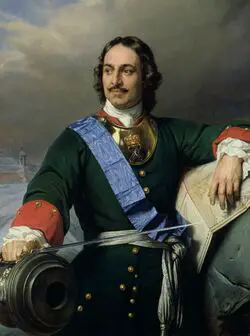
Portrait of Peter the Dandy
Peter the Great is 1 of the most important figures in Russian History. He was a larger-than-life effigy, and he became a legend in his ain lifetime. More than whatever other person, this Tsar inverse the direction of Russian history, and many believe that he transformed the country and opened it upwardly to the westward.
What was Russia like earlier Peter the Great?
Russia was a vast and sprawling country, but it was backward and traditional. Nether the Romanov Dynasty, the country had expanded and had become a vast kingdom. While Europe was modernizing and developing new technologies and ideas, Russia remained insular. Information technology had few urban centers, no real infrastructure, and it was an agrestal society. Much of the country was ruled past Boyars or nobles who ruled vast estates almost every bit independent sovereigns. They regularly defied the Tsar'southward orders, and they competed for influence over the Tsars. Russia, despite being rich in resources, was poor.[1]
This was considering the government of the country was archaic. Much of the population were serfs, who were not legally complimentary and effectively owned by the landowning class. Russia was still very much a feudal society even as Europe was about to enter the Enlightenment. The Russian Orthodox Church was also mighty, and its Patriarch was second in power just to the Tsar. Many enemies encircled Russia. It was menaced by many powerful enemies, including the Swedish and Ottoman Empires, who frequently threaten its territories.[2]
Who was Peter the Great?
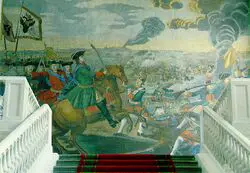
Mosaic of Peter the Great at Poltava
Peter was born in Moscow, Russia in, 1672. He was the 14th child of Tsar Alexis by his second married woman. After the expiry of his father, he jointly ruled with his brother Ivan 5 from 1682. Ivan died in 1696, and then Peter ruled lonely. The Tsar was a giant of a man and was unpredictable and decumbent to vehement outbursts. Peter was a curious human being by nature, and he wanted to make his kingdoms strong and protect them from their many enemies. To do this, he wanted to modernize his realm. He likewise wanted to strengthen his ain position regarding the local aristocracy.
As a youth, he and his brother were dominated by the Boyars, and for the rest of his life, he distrusted them. Early in his reign, Peter solidified his rule crushed a rebellion by Moscow'southward soldiers who supported his half-sister. He had her later sent to a nunnery. Peter, in the first years of his reign, had to suppress many rebellions. He remained a ruthless leader.[3]
This did not finish him from modernizing his country. The Tsar appointed many western advisors to his court and fabricated western dress compulsory. Peter later toured Europe, which was known as the Great Embassy, and he learned much most the w and particularly its new technologies. When he returned, he was e'er more determined to modernize his country. Peradventure the main motive that drove the Tsar to transform his realm was to secure a military advantage. Tsar Peter was an expansionist, and he wanted to secure warm h2o ports that would improve Russian federation's access to the sea. He fought wars with Sweden and Turkey to secure these ports. Peter seized territory in Estonia, Latvia, and Finland and land from the Ottoman Empire.
By 1710 Russia had admission to the Baltic and the Black Sea. In the Dandy Northern State of war, the Swedish King, Charles XII, inflicted a humiliating defeat on Peter at the Battle of Narva. The Swedish monarch, who was a military genius, defeated Poland and Denmark. A Swedish attempt to march on Moscow was defeated, but this did non deter the Swedes.
Charles invaded Ukraine to join upward with rebellious Cossacks. Peter defeated the Swedish army by purposely directing their troops to the city of Poltava during an unbearable Russian winter, and there he surrounded them and annihilated Charles XII'south army. In the backwash of his victory over Sweden, Peter founded a city on the Baltic Coast and named it Petersburg. This urban center was a symbol of the pivot that Russia was making under the Tsar, and it became known as Russia's 'window on Europe.'[4]
By this time, Peter was the absolute ruler of Russia, and in 1721 he named himself equally Emperor of All Russia, Great Father of the Fatherland, and "the Swell." Peter was a reformer, but he was like previous Tsars, and he had a reputation for existence bloodthirsty and fell. He was even cruel to his own family unit. He sent his showtime wife to a nunnery and had a son convicted of treason, and was secretly executed in 1718. Peter the Corking died on Feb 8, 1725, without nominating an heir. He is entombed in the Cathedral of Saints Peter and Paul, located in Saint petersburg. It is reported that when asked who should rule after his death, he whispered 'the strongest.'[5] Stability was only restored after many years when his daughter Elizabeth became Tsarina.
Why did Peter the Swell give landowners more ability over Serfs?
Peter'south reign saw fifty-fifty bang-up controls imposed on the serfs. Peter gave the Boyers and the landowning grade more powers over the serfs. Peter passed laws that formalized the landowners' rights well-nigh the serfs, and equally a effect, the unfree course became e'er more dependent on their masters. Peter gave estate-owners new powers, including requiring no serf to leave his chief'south lands without their written permission. He too placed new financial burdens on the serfs.
The tax organisation that Peter established was very oppressive to the poor and the serfs. The Tsar who owned extensive estates created a class of land serfs or state peasants. They had more freedoms than the boilerplate serf, and they paid their rent and dues directly to the state. Despite his reputation as a modernizer, the Tsar helped to strengthen the feudal society in his country and reinforced the establishment of serfdom that had a fall into abeyance in western Europe in the Middle Ages.[half-dozen]

How did Peter the Great change the Russian Economy?

Statue of Peter the Great
The Great Northern War required unprecedented economic resource, and Peter needed new revenue streams to pay for his reforms and wars. The government was in a dire fiscal position because of Peter'due south lavish expenditure. To enhance money, Peter monopolized the salt, vodka, and coal industries. Peter devised many ways to raise acquirement, even a tax on beards that caused an uproar amongst traditional Russians.
The Tsar was persuaded that he needed to engage in major taxation reform. The solution was a new poll tax that replaced all other taxes. The revenue enhancement burden on the poorer orders increased dramatically. Peter introduced many new technologies into his country from the due west, which helped boost the economic system.
However, the country remained agrarian and private enterprise was stymied by the vast land monopolies and heavy taxation. Peter began industrialization in his country when he set upwards state workshops in the cities and towns. To boost, Russian manufacturers also pursued proto-protectionist merchandise policies, placing heavy tariffs on imports and merchandise to maintain a favorable environment for Russian-made goods. Every bit a result, Peter did not really modernize the Russian economy equally he tightly controlled information technology, and the country'due south economy did not fundamentally modify.[vii]
Which Administrative Reforms did Peter the Great Establish?
Peter'southward administrative reforms all sought to counter the influence of the Boyars. The Tsar hated the nobles and did not trust them, and many were opposed to his reforms as they threatened their privileges. Peter the Great established the Table of Ranks. This was a circuitous system of titles and offices. The table had 20-four ranks. Each rank had its ain level of service to the Tsar. The Table of Ranks' institution was an attack on the Boyars' power and transformed Russian society.[8] The reform abolished hereditary office property and allowed new people to join the bureaucracy and land service.
Peter established a meritocracy in the bureaucracy and to a lesser extent in the military. A new generation of technocrats emerged that dominated Russian federation's ceremonious service and who were, dissimilar the nobles, loyal to the Tsar. The new ceremonious service governed Russian federation for ii centuries. The Communists only abolished the Tabular array of Ranks in 1917. Peter as well established a series of ministries for the first time based on the European model.
He also set up a Senate which was designed to counsel the Tsar. The Tsar was an autocrat, and he gave sweeping powers to the bureaucracy and the elite. He also concluded the autonomy of the Patriarch of the Orthodox Church, and he turned the Church into a department of the state. The Tsar totally dominated the Church just as he did all other aspects of Russian life.[ix] Despite his reforms, Russia remained an autocracy, and Peter was an absolute ruler.
The Russian army that Peter inherited was a semi-professional person militia that was recruited from villages and estates. The soldiers were poorly trained and armed. Peter knew that they were non able to match the Swedes and Ottomans on the battleground. The Tsar turned the armed forces into a professional person force.[10] He appointed western officers to his army and trained them.
Peter as well established arsenals and workshops that produced modern weapons for the new army. Tsar Peter established a standing army in 1699, and he passed a police that conscripted some serfs and nobles for life. Despite his many reforms, the nobles officered many units in the new regular army. Peter was specially eager to establish a new navy. Before his reign, Russia did not have a real maritime presence and was essentially landlocked. Peter imported skilled artisans and established shipyards. In doing so, the monarch created the showtime Russian Navy, which immune Peter to project his military machine power and helped boost maritime trade.
How Peter the Great Westernize Russian federation?
Many historians debate that Peter initiated a cultural revolution that transformed Russian federation and changed information technology from a traditionalist and even medieval social club into one deeply influenced by the west. Certainly, Tsar Peter was securely influenced by the Westward. He introduced many new ideas and technologies into his country. Many westerners came to settle in the country. Many indicate to the City that he founded, St Petersburg, which became a truly European urban center. Peter build many churches and stately buildings on his foundation, and his successors continued this. Indeed, the metropolis was to go Russian federation's cultural middle. It became the home of many swell Russian writers and composers.
However, Peter did not really modernize his state. He was an autocrat, and he became an absolute ruler. Some Tsar critics country that he created a police state in Russia and created a rigid and stratified lodge, where well-nigh of the populace were serfs.[11] The Tsar reforms did not alter Russia and remained a feudal and traditional society until the reign of Tsar Nicholas II in the 19th century.
Determination
Peter the Great is widely regarded as 1 of the founders of modern Russia. In that location are no doubts about his many and varied achievements. He defeated the Swedish Empire and turned his realm into a true Empire. Peter opened Russian federation to the Westward, curtailed the nobility's ability, and created a modern land that could compete with other European countries. The Tsar also established the great urban center of St Petersburg, which became one of Europe'southward great cultural centers.
However, Peter should not be a truthful modernizer. The Tsar turned Russia into a feudal society at a time when the rest of Europe was liberalizing. Individuals had very few rights, including members of the nobility. In that location was no opposition tolerated in Russian federation, and not fifty-fifty the Church had whatsoever liberty. Peter the Great did create a Russian Empire, simply it was not a modern order or orientated towards Europe. The Tsar was an autocrat, and he created an accented monarchy in Russia, which resulted in a feudal and highly stratified society.
References
- ↑ Bushkovitch, Paul. Peter the Great: The Struggle for Ability, 1671–1725 (Cambridge, Cambridge Press, 2001), p six
- ↑ Bushkovitch, p. 134
- ↑ Anisimov, Evgenii V. The Reforms of Peter the Great: Progress Through Violence in Russia (London, Routledge, 2015), p. 187
- ↑ Anisimov, p. 159
- ↑ Masie, p. 214
- ↑ Anisimov, p 115
- ↑ Robert K. Massie, Peter the Nifty: His Life and Earth (London, Random House Publishing Grouping, 2012), p. 22
- ↑ Masie, p. 113
- ↑ Massie, p. 156
- ↑ Anisimov, Evgenii V. "The Reforms of Peter the Peachy: Progress through coercion in Russian federation, trans." John T. Alexander (Armonk, NY: ME Sharpe, 1993), p. 186
- ↑ Meehan-Waters, B. "The Russian Aristocracy and the Reforms of Peter the Great." Canadian-American Slavic Studies viii, no. 2 (1974): 288-302
chifleyhaddespeame79.blogspot.com
Source: https://dailyhistory.org/In_what_ways_did_Peter_the_Great_change_Russia
0 Response to "What did Peter the Great do to modernize Russia?"
Post a Comment