Examples of Infinitives Used as Adjectives
Verbals
1. Gerunds
A verbal is a word formed from a verb but functioning as a different part of speech.
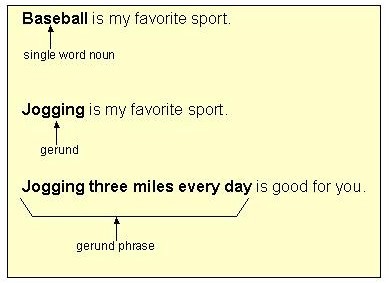
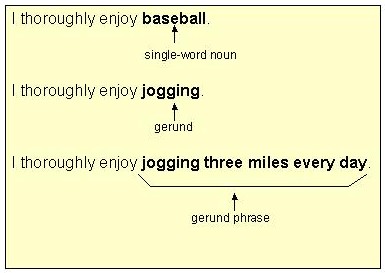
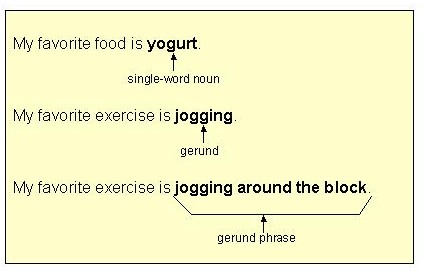
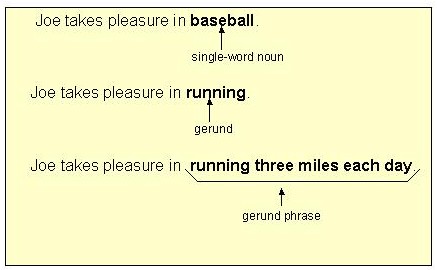
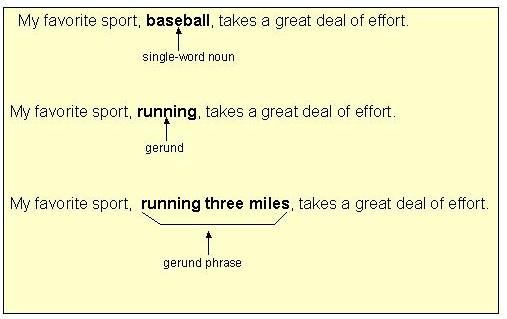
A gerund is a verbal ending in -ing that functions as a noun.
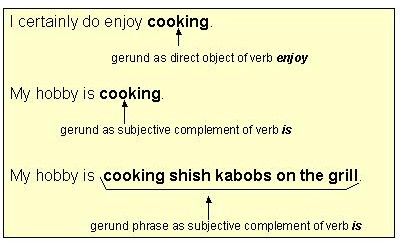
Like an ordinary single-word noun, a gerund may be used as a
SUBJECT
DIRECT OBJECT
RETAINED OBJECT

SUBJECTIVE COMPLEMENT
OBJECT OF PREPOSITION
APPOSITIVE
DELAYED APPOSITIVE
In the example below, the gerund phrase renames the subject, this .

NOTE: Do not confuse gerunds with verbs (predicates) in the progressive tense.
GERUND
PREDICATE VERB
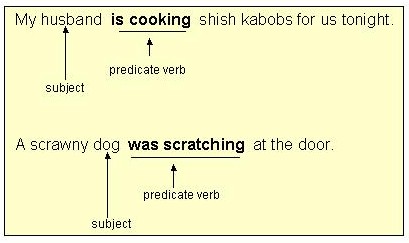
Even though is cooking and was scratching end in -ing, they are not gerunds because they are used as predicate verbs, not as nouns.
2. Participles
A verbal is a word formed from a verb but functioning as a different part of speech.
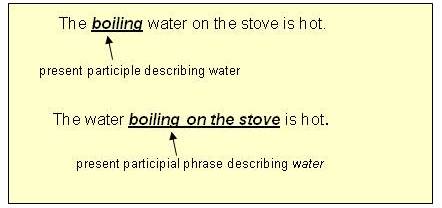
A participle is a verbal that functions as an adjective.
Two kinds of participles:
A. Present participles, always ending in -ing , are created from the form of a verb used with the verb to be ( am, is, are, was, were, been) as an auxiliary verb (progressive tense).
Removing the auxiliary verb and using the -ing form of the main verb as an adjective produces a present participle.
B. Past participles, usually ending in -ed or -en , are created from the form of a verb used with the verb to be as an auxiliary verb (passive voice).

Removing the auxiliary verb and using the -en form of the main verb as an adjective produces a past participle.
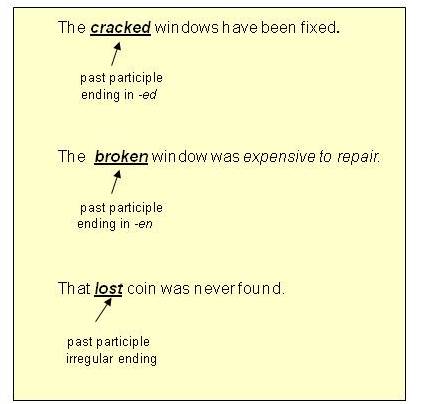
Past participles may also be part of a participial phrase.
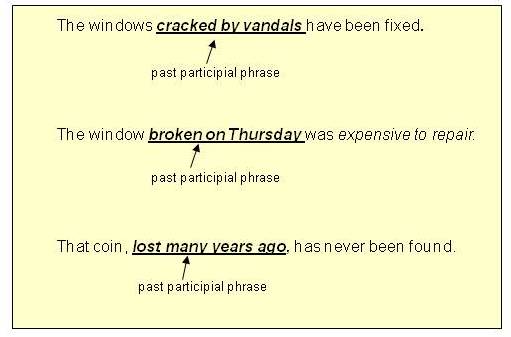
Participles and participial phrases should be placed near the nouns they modify. They may either precede or follow a noun.
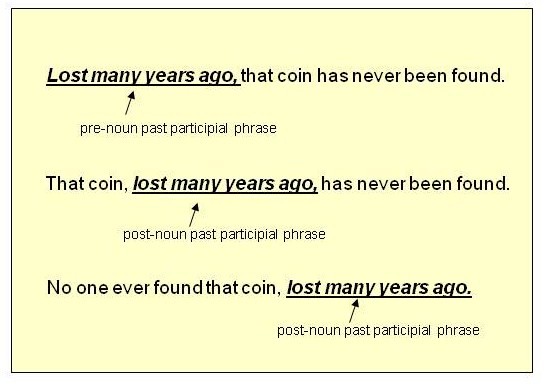
For punctuation rules used with participles and participial phrases, follow this link.
3. Infinitives
A verbal is a word formed from a verb but functioning as a different part of speech.
An infinitive is a verbal formed by placing to in front of the simple present form of a verb.
Examples:
to swim to think to read to be to cut to turn
Infinitives may function as adjectives, adverbs, or nouns.
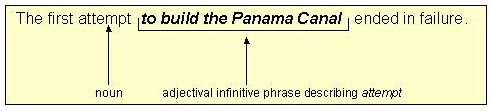
A . Adjectival infinitives
Just like a single-word adjective, an infinitive used as an adjective always describes a noun.
An adjectival infinitive always follows the noun it describes.
EXAMPLE

Like gerunds and participles, infinitives may incorporate other words as part of their phrase.
EXAMPLE
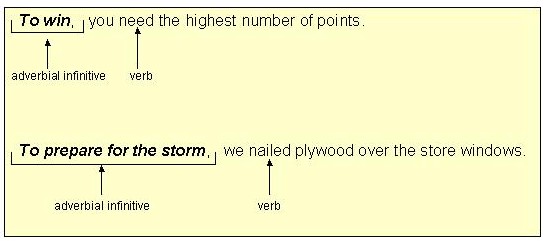
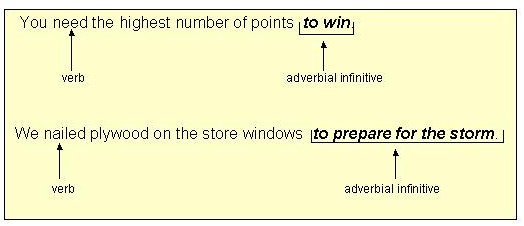
B . Adverbial infinitives
Just like a single-word adverb, an infinitive used as an adverb always describes a verb.
An adverbial infinitive usually occurs at the beginning or at the end of a sentence and does not need to be near the verb it describes.
EXAMPLE: Adverbial infinitive at sentence beginning
EXAMPLE: Adverbial infinitive at sentence end
HINT: You can always identify an adverbial infinitive by inserting the test words in order in front of
infinitive. If the words in order make sense, the infinitive is adverbial.
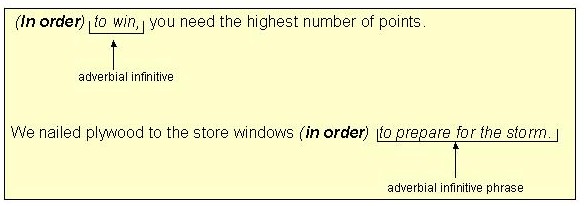
PUNCTUATION NOTE:
1. Use a comma after the adverbial infinitive when it starts a sentence.
2. Do not separate the adverbial infinitive from the rest of the sentence if the infinitive ends the
sentence.
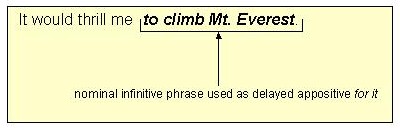
C . Nominal infinitives
Like a single-word noun, a nominal infinitive may function as a
SUBJECT

DIRECT OBJECT

RETAINED OBJECT

SUBJECTIVE COMPLEMENT

APPOSITIVE

DELAYED APPOSITIVE
Examples of Infinitives Used as Adjectives
Source: https://webapps.towson.edu/ows/verbals.html
0 Response to "Examples of Infinitives Used as Adjectives"
Post a Comment